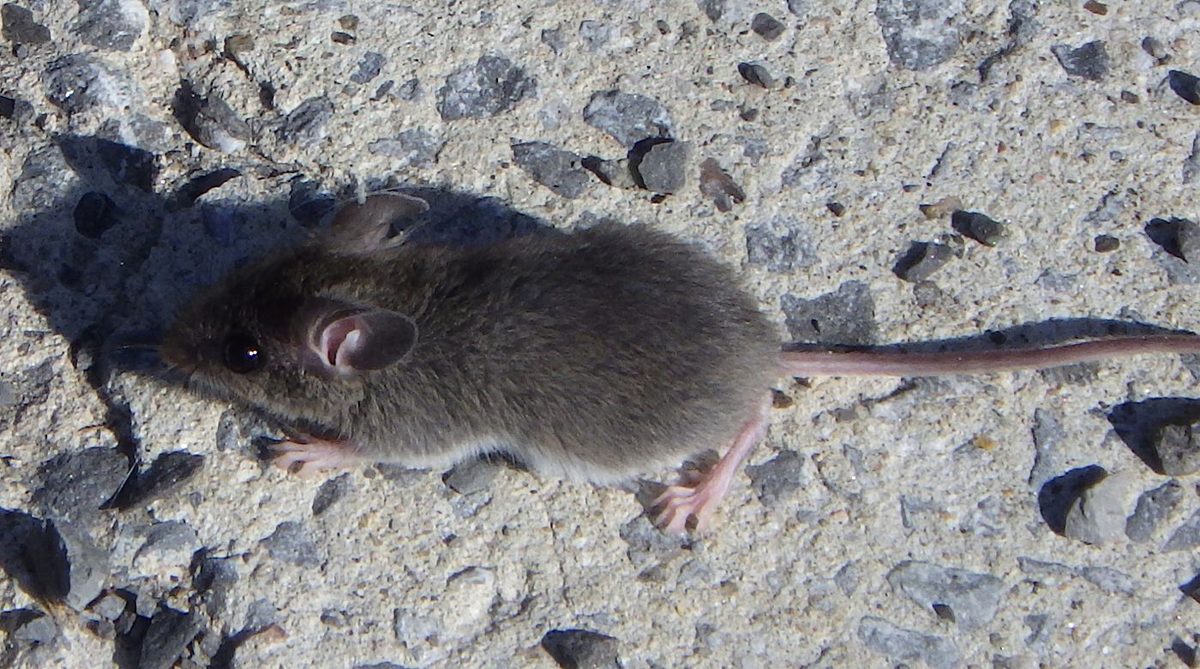
Mouse droppings are small, dark pellets about an eighth to a quarter of an inch long, roughly the size of a grain of rice, with pointed ends. You usually find them scattered along walls, in drawers, under sinks and in pantries, often dozens at a time.
You cannot reliably tell a house mouse dropping from a deer mouse dropping by looking. That matters around Spokane, because deer mice can carry hantavirus. Clean all mouse droppings as if they might be from deer mice.
What mouse droppings look like
Mouse droppings are:
- About an eighth to a quarter of an inch long
- Thin and rod-shaped with pointed ends
- Dark brown to black when fresh, turning gray and crumbly as they age
- Scattered rather than piled, because mice drop them as they move
Rat droppings are much bigger, about half an inch to three quarters of an inch, with blunt ends. See rat droppings identification.
Other things get mistaken for mouse droppings. Cockroach droppings are smaller and have ridges along the sides. Bat droppings crumble into shiny bits when crushed and pile up under roosts. If you are not sure, a technician can tell you.
Where you find them in Spokane homes
House mice live close to food and warmth, so droppings show up:
- In kitchen drawers, especially the silverware drawer
- Under the sink and behind the stove, dishwasher and refrigerator
- In the pantry, near cereal, rice, pet food and bird seed
- In the garage along walls and in boxes
- Behind the washer and dryer
- In the crawl space and attic insulation
Deer mice turn up more in sheds, cabins, campers, barns and garages, especially on rural lots and near fields and pine. Finding droppings in a closed-up space after winter is a classic deer mouse situation.
A cluster of droppings in one spot often marks a nest or a feeding area. A trail along a wall marks a runway.
Droppings in a closed space? Have it cleaned safely.Free call. You are connected with an independent provider near you.
(509) 401-4897Tap to callWhy deer mouse droppings need extra care
The Washington State Department of Health says the deer mouse is the major carrier of Sin Nombre virus, which causes hantavirus pulmonary syndrome, and that most Washington cases were exposed in eastern counties. Spokane Regional Health District has said the virus is found in mouse urine, droppings and saliva and gets into the air as mist or dust.
That is why sweeping and vacuuming are the problem. They break up dried droppings and throw dust into the air you breathe. Wetting everything first with disinfectant keeps it down.
The state sees about 1 to 5 cases a year, so the risk to any one person is small. The cleanup steps are easy enough that there is no reason to skip them. Read deer mice and hantavirus in Spokane for the full picture.
How to clean up mouse droppings
These are the CDC steps:
- Open doors and windows for 30 minutes. Leave the space while it airs out.
- Wear rubber or plastic gloves.
- Spray droppings, urine and nesting material with disinfectant or a mix of 1 part bleach to 9 parts water until wet.
- Let it soak for 5 minutes, or as the label directs.
- Wipe up with paper towels and put them in a plastic bag.
- Disinfect the area again, including countertops, cabinets and drawers.
- Bag the waste, put it in the garbage and wash your hands.
Throw away any food mice may have touched. Wash dishes and utensils from drawers with droppings in hot soapy water.
For heavy contamination in a shed, cabin, crawl space or attic, CDC says workers should wear full protective gear including a respirator. That is a good job to hand off. See droppings cleanup.
After the cleanup
Droppings mean mice are getting in somewhere. Set snap traps along the walls where you found them, find the gaps and seal them. CDC says a mouse can fit through a hole about a quarter inch across.
Watch the cleaned area for a week. New droppings mean mice are still active. If they keep coming, read how to get rid of mice in Spokane or call a mouse technician.
Using droppings to find the problem
Mouse droppings are a map. A heavy cluster usually marks a nest or a favorite feeding spot. A line along a baseboard marks a runway. Droppings near a pipe under the sink often point to the gap mice are using to get in.
Clean an area, then check it each morning for a few days. New droppings show where mice are still active, which is where traps should go. If droppings show up in a new room, mice may be spreading through the walls.
Talk to a local rodent technicianFree call. Ask for a written plan and quote before any work starts.
(509) 401-4897Tap to callCommon questions
How can I tell mouse droppings from rat droppings?
Mouse droppings are about the size of a grain of rice with pointed ends. Rat droppings are about half an inch or longer with blunt ends.
Can I tell if droppings are from a deer mouse?
Not reliably by looking. Treat all mouse droppings, especially in sheds, cabins and garages, as if they could be from deer mice.
Is it safe to vacuum mouse droppings?
No. CDC says not to vacuum or sweep them. Wet them with disinfectant, wait 5 minutes, then wipe them up.
How many droppings does one mouse leave?
Mice leave a lot of droppings as they move. A few mice can leave dozens in a night, so lots of droppings does not always mean lots of mice.
Do deer mouse droppings look different?
Not in a way you can rely on. Both are small and dark with pointed ends. Where you find them is a better clue: deer mice favor sheds, cabins, garages and outbuildings near open ground.